LED grow lights for houseplants in winter: light, distance, duration and Home Assistant
 Andrea R.
Since the clocks went back in late October, days have been getting shorter fast. For a pothos, a ficus or kitchen herbs sitting away from a window, this is the start of the low-light season. An LED grow light can fill the gap, as long as you pick it well, hang it at the right distance and run it long enough, but not too long.
This is a method guide. We have not tested any grow light: the guidelines below come from basic horticultural lighting concepts and manufacturers' spec sheets, and the Home Assistant part describes standard automations. Exact values depend on each lamp, so always follow your own lamp's manual.
Why houseplants run short of light in winter
Behind glass, a plant already gets far less light than outdoors. In winter the sun is lower, days are shorter and skies are more often overcast.
The classic signs: stems stretching toward the window, smaller or paler leaves, growth that stalls. A plant short of light also drinks less, which is why winter is when the most plants get overwatered, as we explain in our article on heating season and houseplant watering.
Light: the three numbers to read on a spec sheet
Lumens and watts say almost nothing about how useful a lamp is for plants. Serious spec sheets list other values.
PPFD
PPFD (photosynthetic photon flux density, in µmol/m²/s) tells you how much "usable" light reaches the leaves at a given distance. It is the most important figure. A good manufacturer publishes a PPFD map at several heights; without it, it is hard to know what the lamp really delivers.
DLI
DLI (daily light integral, in mol/m²/day) combines intensity and duration: the total light received over the day. It explains why a modest lamp left on for long can match a powerful one used briefly. To estimate it: PPFD × hours of light × 3,600 ÷ 1,000,000.
Spectrum
Plants mainly use blue and red. Purple lamps (blue + red only) work, but make a room unpleasant. For a living room, a broad-spectrum "horticultural white" LED is more comfortable and is enough for foliage plants.
What different plants need
No need to aim high for every plant. Three broad groups are enough to get your bearings:
- Low light: pothos, snake plant, ZZ plant, philodendrons. A modest top-up is often enough.
- Medium light: ficus, monstera, calathea, most living-room foliage plants.
- High light: herbs, cacti and succulents, seedlings, flowering plants. These benefit most from a lamp in winter.
For precise targets (PPFD or DLI), check the lamp maker's or your garden centre's recommendations: they vary by species and source.
Distance: not too close, not too far
Light drops quickly with distance: moving the lamp up covers a wider area, but less intensely. That is why a PPFD-by-height map is so useful.
A few simple rules:
- Start from the height the manufacturer recommends, then adjust.
- Too close: top leaves yellowing, bleaching or drying. Raise the lamp.
- Too far: stems stretching toward the lamp. Lower it.
- Measure to the top of the foliage, not the pot.
- Raise the lamp as the plant grows.
A clip-on grow bulb suits a single plant. For a shelf, one LED bar per level lights more evenly than one big lamp.
Duration: how many hours a day
Plants need a night phase. Leaving a lamp on 24/7 does not help and wastes electricity.
The most common guideline is 12 to 16 hours of total light per day (daylight included), with a real dark period. Low-light plants are fine at the low end; herbs and seedlings like the high end.
Consistency matters as much as duration: same hours every day. That is exactly what an automation does better than a human.
Automating the lamp in Home Assistant
A regular grow light does not need to be "smart". A simple smart plug is enough to switch it from Home Assistant. A Zigbee, Thread or Matter plug works locally, without the cloud: our Matter, Thread and Zigbee guide explains how to choose.
1. A fixed schedule
The simplest option: on in the morning, off in the evening, at the same time every day.
automation:
  - alias: "Plant lamp - on"
    trigger:
      - platform: time
        at: "07:00:00"
    action:
      - service: switch.turn_on
        target:
          entity_id: switch.plant_lamp_plug
  - alias: "Plant lamp - off"
    trigger:
      - platform: time
        at: "21:00:00"
    action:
      - service: switch.turn_off
        target:
          entity_id: switch.plant_lamp_plug
Replace switch.plant_lamp_plug with your plug's entity. This gives 14 hours of light: adjust for your plants.
2. Topping up the sun instead of replacing it
For a plant near a window, you can switch the lamp on only at the end of the day, for example at sunset (sun trigger, sunset event), then off at a fixed time. Total light time stays roughly constant even as sunset gets earlier.
3. Based on measured brightness
If you have a light (lux) sensor near the plants, add a condition: only switch on when the room is dark. It is an approximation (a lux sensor does not measure PPFD), but it avoids running the lamp in full sun.
4. Tracking consumption
Many smart plugs measure power. In Home Assistant's Energy dashboard you will see what the lamp really costs over the winter.
Light and watering go together
A well-lit plant starts growing again, so it drinks more. After adding a lamp, watch the soil moisture rather than keeping your old watering rhythm.
That is where a soil sensor helps, triggering an alert or watering at the right time. We cover what is available in our article on Matter soil sensors and Home Assistant.
Safety and common sense
- Use a plug and power strip rated for the lamp, away from water splashes.
- Avoid looking straight into a powerful LED, especially purple models.
- Make sure the lamp does not heat a nearby leaf or curtain.
In short
- Choose a lamp whose maker publishes PPFD by height.
- Set the distance by watching the plant, and raise the lamp as it grows.
- Aim for 12 to 16 hours of light a day, with a real night.
- Hand the schedule to Home Assistant through a local smart plug.
- Adjust watering: more light, more thirst.
For more ideas, see all our articles on the Plants planet.
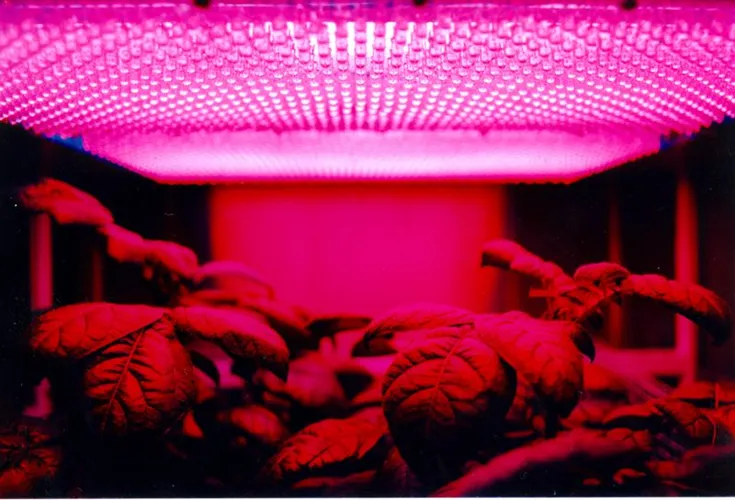
Photo: LED plant-growth panel, NASA Marshall Space Flight Center (public domain, via Wikimedia Commons). No lamp mentioned in this guide has been tested by Rocks on Galaxy, and this article contains no affiliate links.