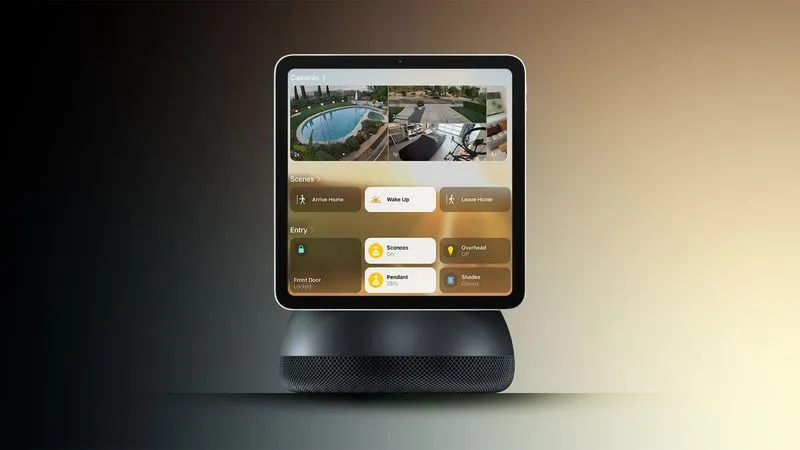
Apple HomePad: smart home hub reportedly coming October 13, 2026
- News
- Rocks on Galaxy
- Maison connectee
- 05 Oct, 2026
- 0
Apple is set to launch its first smart home hub on October 13, 2026: a small display of roughly 6 inches with a design inspired by the iMac G4, according to Bloomberg. It would arrive alongside a new HomePod mini and a new Apple TV 4K. None of this has been confirmed by Apple yet, so here's what comes from the report and what remains unknown.
The name "Apple HomePad" isn't official. It's the nickname used by part of the tech press, including 9to5Mac.
What Bloomberg is reporting
The news comes from Bloomberg's Mark Gurman. On September 30, he reported that Apple plans to make its long-delayed entry into the smart home market on Tuesday, October 13. According to Bloomberg, it would be a major milestone for the company under its new CEO, John Ternus.
An earlier report from the same source only pointed to a launch "as early as October." This one sets a specific date. As MacRumors and Forbes sum it up, three products are involved: the hub, a HomePod mini and an Apple TV.
This isn't a new topic for us: we already covered the Apple smart home display expected in late 2026. The difference is that there's now a date on the table.
J490 and J491: a hub that recalls the iMac G4
Again according to Bloomberg, the device carries the code name J490. It would take the form of a square display of about 6 inches, designed to sit on a countertop. A second version, code-named J491, would be meant for wall mounting, with a slimmer base lying flat beneath the screen.
The tabletop version is the one getting attention. The screen would sit on a round metal base, perforated with several rings of speaker holes, connected by a polished metal arm. Users could tilt the display forward or backward by hand. It's hard not to think of the 2002 "sunflower" iMac G4, a comparison Bloomberg makes itself.
Other reported details include:
- a single front-facing FaceTime camera, with no rear camera;
- microphones and speakers housed in the base;
- a thickness close to that of an iPhone, with a black border of about a quarter inch;
- no battery: the device would need to stay plugged in at all times, via a USB-C port;
- no volume or power buttons;
- a gray aluminum finish and a rubberized underside for stability.
These details are quoted by Daring Fireball, which cites excerpts from the Bloomberg article. They remain unconfirmed by Apple.
Siri, AI and recognizing household members
Siri is reportedly behind the delay. According to MacRumors, summarizing Bloomberg, all three devices were originally planned for 2024 and are meant to showcase the new, AI-powered version of the assistant.
The hub's headline feature would be its ability to recognize who is speaking to it or walking up to it, by voice or facial recognition. The screen would then show that person's contacts, messages, appointments, notes and preferred app layout, and switch automatically when another household member steps in. A guest mode would hide personal information.
Bloomberg notes that facial recognition would be less reliable than Face ID on iPhone. Users could require secondary authentication through an iPhone, which would also serve as a fallback if recognition fails.
On the software side, descriptions vary from outlet to outlet. 9to5Mac describes a new operating system blending elements of iOS, tvOS and watchOS, while Forbes mentions a tvOS foundation. Android Authority points to iPad-style app panels, a watchOS-inspired icon grid, and clock and photo screens similar to iOS StandBy. The system's name isn't known.
HomePod mini and Apple TV: same look, new chips
October 13 wouldn't be just about the hub. According to Bloomberg, Apple would introduce the first HomePod mini update since its 2020 launch, and its first new TV box since 2022.
According to MacRumors, both devices would keep their current design but get faster chips to run Siri and its AI features. The HomePod mini would also come in new colors, including pink and green.
What could come later
The report goes beyond October. Again according to Bloomberg, as relayed by MacRumors and Forbes, Apple has other products in the works, with no announced date:
- an update to the full-size HomePod, planned for later;
- a privacy-focused security camera and sensor, able to detect which room a person is in without recording video;
- a higher-end version of the hub, with a 9-inch display mounted on a robotic arm that can rotate 360 degrees.
That robotic model is not expected to be part of the October 13 announcements.
Taking on Google Nest and Amazon Echo
Apple is late to smart displays. Amazon with its Echo Show and Google with its Nest Hub have owned the space for years, while Apple currently offers only HomePod speakers and the Home app.
Android Authority argues the timing could still work in Apple's favor: the site points to frustration among some Google Home users, from automation bugs to a slow transition to Gemini, and to Google prioritizing the Pixel Tablet over a true Nest Hub successor.
One big unknown remains: compatibility. None of the sources we consulted detail Matter or Thread support for this hub. For a comparison with the open ecosystem, see the Home Assistant 2026.10 beta and its new Matter features.
Europe and outside the US: what we don't know yet
The sources are silent on this. None mention pricing, a release date in Europe or other markets outside the US, or which languages the new Siri will support. We also don't know whether all the AI and user-recognition features will be available outside the US at launch.
An announcement on October 13 wouldn't necessarily mean immediate availability everywhere.
How to follow launch day
In his Power On newsletter on October 4, Mark Gurman said Apple "plans to hold an event" that day, MacRumors reports. Its format is still unknown.
If Apple does hold an event, an official invitation should go out in the coming days. That's what will confirm, or not, the October 13 date. Until then, find all our coverage in the smart home section.