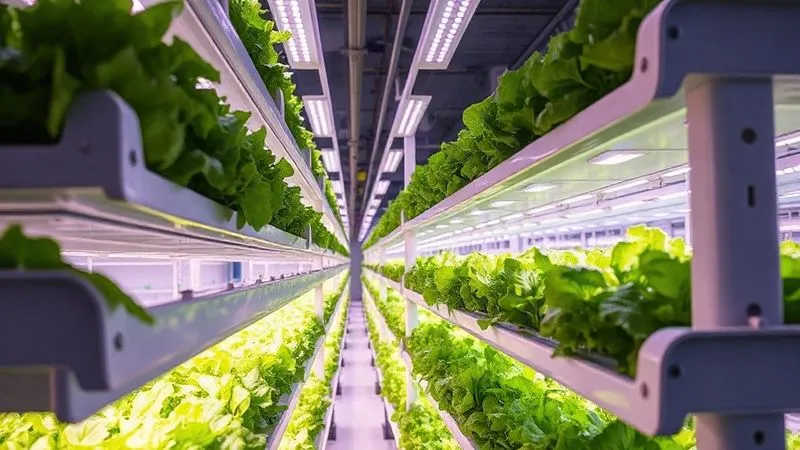
Norway Avisomo: Fully Automated Vertical Lettuce Farm
- News
- Rocks on Galaxy
- Plantes
- 25 Sep, 2026
- 0
The lettuce never meets a human until a kitchen counter. In a September 17, 2026 research briefing, SINTEF described Norway’s first fully automated vegetable facility at Gardermoen near Oslo airport. Operator Himmelgrønt AS is a Coop Norge–Avisomo partnership. The plant went into operation last fall; first products reached store shelves this spring.
How the line works
SINTEF researcher Ottar Bakås: nobody touches the lettuce from sowing through packaging until a customer opens it at home. Robots and automation handle the tasks. Light, air, and water are adjusted automatically. Crops sit in a multi-level shelf system: one seed per unit, roots down into flowing nutrient water, plant on top. The fastest-growing lettuces are ready in just over two weeks. Growing is typically soilless; no pesticides or insects in the described indoor environment, so harvest can be cut and bagged immediately, former SINTEF researcher Aleksander Lillienskiold said.
- Model: indoor stacked “vertical farming”
- Logistics: airport-adjacent site for distribution to Coop stores nationwide
- Shelf-life claim: lettuce and herbs from 2–4 weeks to 12 weeks (facility/research narrative)
- Project: SINTEF AutoGrow, 2025–2026, funded with FFL/JA 279591
What the researchers will not oversell
SINTEF visited other Norwegian growers that mix automation and manual work. Conclusions: technology exists, but cost, complexity, and inflexibility still block many producers; fully robotic greenhouses are not realistic for everyone because plants vary biologically; partial automation (logistics, packing, energy) often beats full robot replacement; energy economics can decide whether a site is profitable. Researchers mention berries, tomatoes, and cucumbers as suitable in principle—not as proven output at Gardermoen. An FFI defence-research note is cited on food-supply vulnerability; local automated production is framed as preparedness, not a yield forecast.
AutoGrow methods and staffing angle
SINTEF’s AutoGrow team mapped automation tools (robots, sensors, cameras, control systems, energy, digital tools), visited Norwegian greenhouses and vertical plants, and assessed what fits smaller Norwegian sites with high energy costs and more varied crops than large foreign greenhouses. Lillienskiold argues robots on harvest ease staffing shortages and reduce heavy/dangerous tasks from an HSE perspective, while remaining jobs become more varied. Bakås wants more facilities nationwide and notes several Norwegian players have ambitious expansion plans. FFI’s food-supply vulnerability note is cited as a preparedness argument for local automated production—not a wartime production quota. The researchers’ bottom line: digitate before you robotize; energy management can matter as much as harvest robots; partial automation often beats a full robotic greenhouse for Norwegian economics.
Rocks take
Solid institutional source, slightly older than the rest of this pack. Treat 12-week shelf life as a stated growing-model claim, not a supermarket lab test we independently verified. Source: SINTEF.
FAQ
Is the farm selling already? SINTEF says first products hit shelves this spring after a fall 2025 start.
Is every Norwegian greenhouse going fully robotic? No—SINTEF says full robotics is not realistic for all growers.