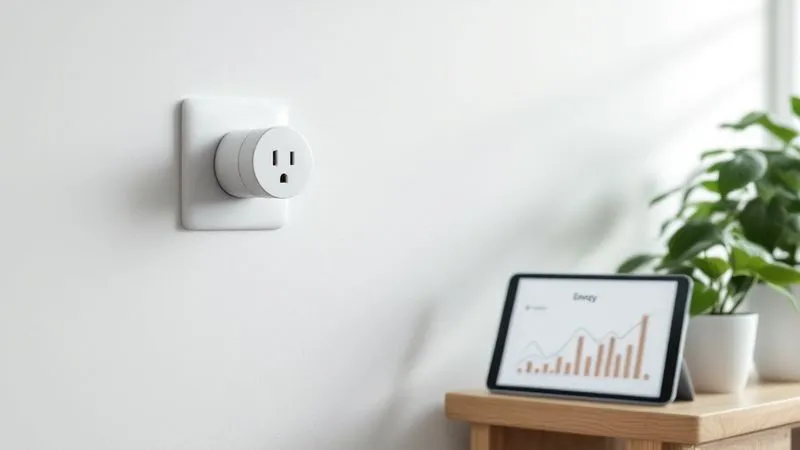
Matter energy monitoring in 2026: which apps really show your smart plug's kWh
- News
- Rocks on Galaxy
- Maison connectee
- 30 Oct, 2026
- 0
Buy a Matter smart plug that "tracks energy", pair it with your phone, and there is a good chance you will see an on/off button and nothing else. The plug is measuring. Your app simply is not listening. That changed a little on October 29, 2026, when Google added Matter energy readings to the Google Home app on Android. It is a good moment to ask a blunt question: in late 2026, which smart home platform actually shows the watts and kilowatt-hours a Matter plug reports, and which one lets you do something with them?
This guide answers that platform by platform, explains why some plugs still show nothing, compares three plugs that report energy over Matter, and walks through the Home Assistant setup that remains the most complete option.
Key takeaways
- Since Google's October 29, 2026 update, compatible Matter plugs and energy monitors that measure cumulative usage show real-time power and total kWh on their tiles in Google Home for Android.
- Apple Home on iOS 27 has an Energy tab that includes accessories such as smart plugs, but that data cannot trigger automations.
- Amazon's published list of supported Matter clusters maps plugs to on/off only: no Matter energy data in Alexa today.
- Home Assistant reads the Matter power and energy clusters as normal sensors that you can graph, add to the Energy dashboard and use in automations.
- The cheapest way to test all this is an IKEA GRILLPLATS ($7.99 / €7.99), provided you already have a Thread border router.
What Google changed on October 29
The Google Home release notes dated October 29, 2026 list a feature called "View energy data on supported Matter devices" for Android. In Google's wording, compatible Matter smart plugs and energy monitors "that measure cumulative energy usage" now display both real-time power and total energy consumed (kWh) directly on their device tiles and controller screens. The same update fixes icons for Matter closures (garage doors, gates, windows, blinds) and adds a one-tap energy-saving shortcut for thermostats.
Two caveats are worth keeping in mind. First, the notes cover Android; Google does not mention iOS for this item. Second, Google states that its release notes are drafted with the help of Gemini and may need corrections, and like most Google Home features the update rolls out progressively. The press coverage from 9to5Google and Android Authority reports the same scope. What the notes do not mention is any new automation starter based on power or energy, so for now this is a display feature.
The five-platform scorecard
Here is where each major ecosystem stands with a Matter plug that reports power and energy, based on official documentation and release notes available on October 30, 2026.
| Platform | Live power (W) | Cumulative energy (kWh) | Usable in automations | What you need |
|---|---|---|---|---|
| Google Home (Android) | Yes, since Oct 29, 2026 | Yes, on plugs that measure cumulative usage | Not announced | Google Home app on Android, Matter hub from Google, Thread border router for Thread plugs |
| Apple Home (iOS 27) | Not documented | Yes, in the Energy tab | No | iOS 27 plus an Apple TV on tvOS 27 or a HomePod on HomePod Software 27 |
| Amazon Alexa | No | No (Alexa's energy dashboard relies on its own cloud APIs) | No | Plug appears as on/off only |
| Samsung SmartThings | Yes on supported plugs | Yes on supported plugs | Yes, in Routines | SmartThings hub; some brands still route energy through their cloud link |
| Home Assistant | Yes, as a sensor | Yes, as a sensor | Yes, any automation | Matter integration (Matter Server), Thread border router for Thread plugs |
The Apple row comes from MacRumors' iOS 27 Home guide, which describes an Energy tab that tracks consumption for supported accessories such as smart plugs, without automation support. The Alexa row comes from Amazon's own list of supported Matter device categories and clusters: smart plugs and power strips map to the On/Off cluster and nothing else. For SmartThings, Eve states on its Eve Energy product page that energy management features are currently available on SmartThings and Home Assistant, while TP-Link's own FAQ tells Tapo owners to link their Tapo account to SmartThings rather than pair over Matter if they want energy data there.
Power versus energy: why your plug may still show nothing
Energy reporting has been part of Matter since version 1.3, released by the Connectivity Standards Alliance in May 2024. The specification lets any device report actual or estimated instantaneous power, voltage and current, plus energy consumed or generated over time. In practice those are two separate building blocks:
- Electrical Power Measurement: what the device draws right now (watts, plus voltage and current if the maker implements them).
- Electrical Energy Measurement: the running total, in kilowatt-hours, that you need for daily or monthly figures.
A plug can implement the first without the second. Google's wording is precise on this point: energy totals appear on devices "that measure cumulative energy usage". If your plug only exposes instantaneous power, Google Home can show the live reading but no kWh total. Firmware matters too. Eve added Matter energy reporting to Eve Energy only with an April 2025 update; before that, the data stayed inside Eve's own app.
The last trap is the multi-admin setup. Matter lets you share one plug with several controllers, but each controller decides independently which clusters it understands. The same plug can show kWh in Home Assistant, watts in Google Home and a bare switch in Alexa, all at the same time.
Three plugs that report energy over Matter
We picked three widely sold plugs with documented energy reporting over Matter, one per price band. Prices are list prices from the makers' sites on October 30, 2026.
| Plug | Matter transport | Rating | Energy data over Matter | Price | Watch out for |
|---|---|---|---|---|---|
| IKEA GRILLPLATS | Thread | See local label | Power usage tracking | $7.99 US / €7.99 FR | Needs a Thread border router (DIRIGERA or other) |
| Eve Energy (US/CA 4th gen, EU 4th gen) | Thread | US 15 A / 1,800 W; EU 11 A / 2,500 W | Power, voltage, current, cumulative energy (firmware from April 2025) | $39.95 US | Lower ceiling on the EU model for heaters |
| TP-Link Tapo P110M | Wi-Fi (2.4 GHz) | US 15 A / 1,800 W; EU 16 A / 3,680 W | Energy monitoring, cost estimates in the Tapo app | Varies by retailer | For SmartThings energy, TP-Link recommends its cloud link instead of Matter |
Sources: IKEA US GRILLPLATS page, Eve's Works With Home Assistant announcement and the Tapo P110M product page. If you need an outdoor model, our Aqara Outdoor Plug H2 EU guide covers a 16 A Thread plug with energy monitoring.
Home Assistant: from Matter plug to Energy dashboard
Home Assistant is still the only platform in our scorecard that treats the readings as ordinary data you can store, chart and act on. The setup takes about ten minutes.
1. Commission the plug
Add the Matter integration, which runs the Matter Server app (it is not supported on 32-bit systems). For a Thread plug such as GRILLPLATS or Eve Energy you also need a Thread border router; Home Assistant's documentation notes that the border router only relays encrypted traffic, so any compatible one works. If you are unsure whether Thread or Zigbee fits your home better, see our Zigbee vs Matter over Thread study.
2. Check which sensors appeared
Open the device page. Depending on firmware you should see power (W), energy (kWh), and sometimes voltage and current. If only power appears, the plug is not exposing a cumulative counter.
3. Add it to the Energy dashboard
Under Settings, Dashboards, Energy, add the kWh sensor as an individual device. If your plug only reports watts, create an Integral helper (Riemann sum) from the power sensor to compute kWh, then add that helper instead.
4. Make the data useful
This is where Home Assistant pulls ahead. Three automations we find worth the effort:
- Notify when the washing machine draws under 5 W for three minutes: the cycle is finished.
- Cut a space heater if it has run above 1,000 W for more than two hours.
- Track a dehumidifier or a grow light per month to see what it really costs.
If you also have home batteries, the same sensors can feed the logic we described in our Teslemetry and Powerwall local dispatch guide.
Multi-admin: look in Google, act in Home Assistant
Our take: Google's update is welcome, but it mostly fixes a gap. A plug that reports energy and an app that hides it is a poor experience, and Android users now get the numbers where they expect them. It does not turn Google Home into an energy manager: there is no history comparison, no cost tariff and, as far as the release notes say, no automation based on consumption.
Matter's multi-admin makes the best of both worlds easy. Commission the plug in Home Assistant first, then share it to Google Home (or Apple Home) from the device's Matter settings. Your household gets a familiar tile with live watts, while Home Assistant keeps the long-term history and the automations. If Alexa is your main assistant, as with the new Echo Dot 2026 hub, voice on/off will work, but the energy figures will have to live elsewhere.
Who should care?
- Google Home users on Android: check your existing Matter plugs after the update rolls out. You may already own energy monitoring you never saw.
- iPhone households: iOS 27's Energy tab is enough for curiosity, not for automation.
- Alexa households: do not pay extra for an energy-monitoring Matter plug if Alexa is your only controller.
- Home Assistant users: Matter energy plugs are now a cheap, local, vendor-neutral way to meter individual appliances. Start with one GRILLPLATS on the device you suspect most.
FAQ
Does Google Home show Matter energy data on iPhone?
The October 29, 2026 release notes list the feature for Android only. Google has not announced a date for iOS.
Why does my Matter plug show watts but no kWh?
Your plug probably implements the Electrical Power Measurement cluster but not the cumulative Electrical Energy Measurement cluster. A firmware update may add it; in Home Assistant you can compute kWh with an Integral helper.
Can Alexa read energy from a Matter plug?
Not today. Amazon's documented Matter support for plugs is limited to the On/Off cluster. Alexa's energy dashboard relies on separate cloud integrations from device makers.
Do I need a hub for IKEA GRILLPLATS?
You need a Thread border router, such as IKEA's DIRIGERA or another Matter controller with Thread. It then works with Amazon, Apple, Google, Homey, SmartThings and Home Assistant.