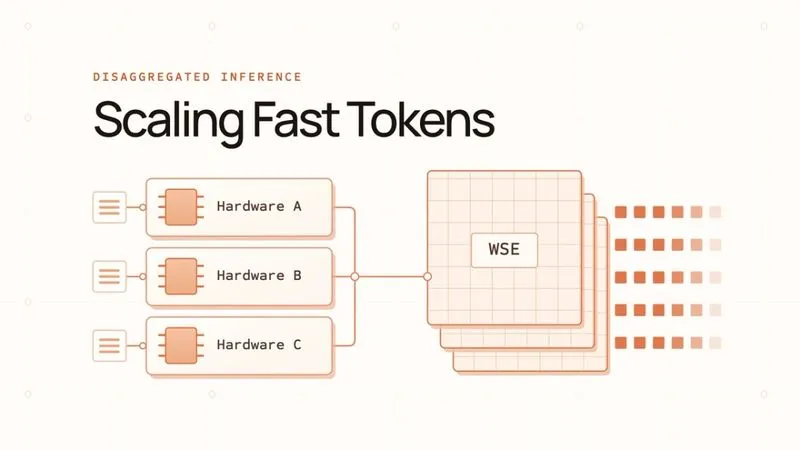
Cerebras Claims 5× Inference Throughput With Disaggregation
- News
- Rocks on Galaxy
- Tech
- 04 Oct, 2026
- 3
More Cerebras tokens without buying more wafers. On October 1, 2026, Unite.AI reported Cerebras’ blog Disaggregated Inference From The Ground Up (Isaac Tai and Zhenwei Gao): early tests of heterogeneous disaggregation raised inference throughput by 5× with the same number of Cerebras systems and no loss in token-generation speed.
Prefill vs decode, split
Inference has two phases with different hardware appetites. Prefill processes the whole prompt in parallel—compute-heavy. Decode emits tokens one by one and leans on the KV cache—memory-bound. Running both on one pool forces schedulers to trade time-to-first-token against smooth streaming and total throughput.
Disaggregation puts the phases on separate hardware pools so each can be sized, batched, and prioritized independently. The cost is shipping the request-specific KV cache from prefill to decode after the prompt is processed; Cerebras frames that overhead as worthwhile at scale.
Heterogeneous twist
- Decode stays on Cerebras WSE systems
- Prefill can run on partner accelerators (diagram cites AWS Trainium and AMD Helios Instinct among options)
- Published-peak chart (Sep 10, 2026): WSE-3 on-chip SRAM at 21,000 TB/s per wafer—SRAM and HBM peaks are different memory tiers, not comparable token speeds
- Artificial Analysis Sep 10, 2026: Cerebras at 1,669 output tokens/s on GPT-oss-120B (high reasoning, 10k input), ahead of SambaNova 708, Groq 475, and cloud peers in that table
Agentic, multi-turn workloads—where context grows across calls and delays compound—are the use case Cerebras highlights for the pattern.
Why aggregated serving hits a wall
In a traditional aggregated server, prefill and decode share the same accelerators. Large parallel prefill jobs can stall in-flight decode streams; schedulers then juggle time-to-first-token, smooth streaming, and total throughput. Batching helps concurrent requests share weight reads, but bigger batches can lengthen each decode step—so aggregate throughput can rise while each user gets tokens more slowly.
Cerebras contrasts its wafer-scale design—SRAM distributed beside compute across the wafer—with GPUs that stage model data from HBM through smaller on-chip caches. The Sep 10 published-peak chart also lists an unnamed on-chip SRAM accelerator at 150 TB/s and HBM4 GPUs around 22–23.3 TB/s; Cerebras cautions those figures describe different memory tiers. Partnerships with multiple hardware partners are framed as the path to bring more ultrafast tokens to market; next blog installments will cover hardware/software stacks and economic trade-offs at scale.
Rocks take
Vendor early results, PR-flagged: treat the 5× claim as company early tests, not an independent bake-off. The architecture story (partner prefill + WSE decode) is clearer than a single headline number. Source: Unite.AI Oct 1 summarizing Cerebras blog same day.
FAQ
Does 5× mean five times faster tokens per user? Cerebras frames throughput capacity with the same WSE footprint and unchanged token-generation speed—not a free latency miracle for every request.
Is the 21,000 TB/s a measured serving speed? No—published-peak on-chip SRAM bandwidth; the chart itself warns SRAM vs HBM are different tiers.