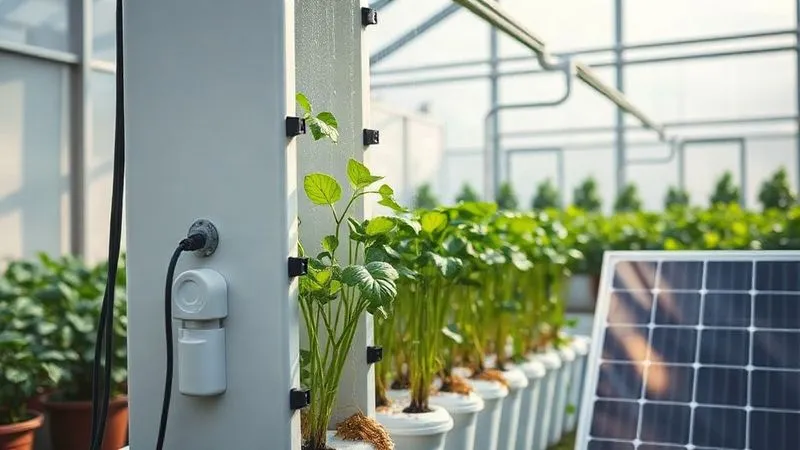
Totem Solar Aeroponics: $719 Open-Source Vertical Farm
- News
- Rocks on Galaxy
- Plantes
- 24 Sep, 2026
- 3
Off-grid greens without a grid bill—or a closed proprietary stack. On September 21, 2026, pv magazine covered Totem, an open-source solar aeroponic vertical farm from researchers at Mexico’s Northwestern Center for Biological Research (Cibnor), published in HardwareX.
What Totem is
Aeroponics suspends roots in a chamber and mists nutrient solution on a schedule, recirculating runoff. Totem’s 1.5 m tower offers 24 planting sites in six staggered rows. An ESP32-Wroom runs the pump and Wi-Fi GUI. Power: a 50 W polycrystalline PV panel charging two parallel 12 V 12 Ah batteries (~288 Wh storage, ~2.7 days without sun per the paper’s estimate). Estimated materials cost: $719.51. Design, firmware, and GUI files are published.
- Trial crop: basil, 55 days, two successive harvests
- Pump schedule: 30 seconds every 30 minutes (48 cycles/day)
- Energy: ~44.9 Wh/day consumed vs ~136.5 Wh/day PV estimate
- Loop: closed nutrient recirculation with 100-mesh filter
Honest limits
Authors say the experiment supports technical feasibility under tested conditions—but comparative agronomic performance and long-term service life need controlled benchmarking. Automated pH and EC management is called out as a next priority. Do not invent multi-crop yield percentages or “commercial ready” claims; this is a documented research prototype.
Why open hardware matters here
Most commercial aeroponic towers lock buyers into proprietary controllers and opaque BOMs. Totem’s contribution, per the researchers and pv magazine’s summary, is the documented integration of structure, hydraulics, electronics, software, and off-grid power with published files and an itemized bill of materials. The 100-mesh Azud filter and low-pressure misting nozzles are ordinary industrial parts—good for repairability in resource-limited settings.
Who should care—and who should wait
Urban food production demos, classroom CEA labs, and off-grid research sites are the intended niches. This is not a claim that Totem replaces commercial greenhouse automation stacks. Single-crop basil success over 55 days is a feasibility data point; multi-cycle longevity, pest pressure, and automated pH/EC remain open work the authors themselves flag.
Rocks take
Useful open hardware for educators and off-grid experimenters; strength is transparency (BOM + files), not a consumer product review. Source: pv magazine.
Rocks will watch for follow-on HardwareX notes on multi-cycle reliability, automated pH/EC modules, and third-party builds that validate the $719.51 BOM in other climates. Educators can already use the published files; commercial growers should keep Totem in the prototype column until comparative yield data exists.
FAQ
Is Totem for sale as a kit? Coverage describes an open-source research system with published files and an itemized BOM—not a retail SKU.
What was proven in the trial? Continuous operation and two basil harvests over 55 days under the stated irrigation and solar assumptions.