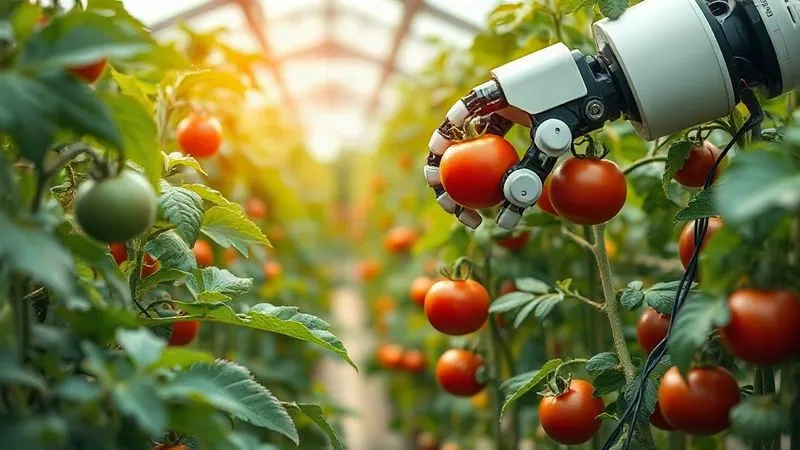
Active Perception Pipeline Locates Hidden Tomatoes in Greenhouse Clusters
- News
- Rocks on Galaxy
- Plantes
- 17 Sep, 2026
- 0
Occluded fruit is still where harvesting robots fail. A preprint posted to arXiv as 2609.18738 on September 16, 2026 describes an active perception pipeline built to find tomatoes buried inside dense greenhouse clusters—not just the easy fruit on the canopy surface.
Why clusters break fixed cameras
The authors argue that prior harvesting perception often assumes fruits grow in relative isolation (apples, peppers, peaches). In Mediterranean greenhouse tomatoes, fixed sensors on a manipulator miss fruits hidden behind leaves and neighboring fruit. The fix is deliberate camera motion: plan a Next Best View (NBV), then reconstruct the full cluster.
Five-stage pipeline
The method chains (i) point-cloud capture via an AgriSEE NBV planner, (ii) Statistical Outlier Removal noise filtering, (iii) Region Growing surface segmentation, (iv) DBSCAN clustering to isolate and recover occluded instances, and (v) 3D pose estimation (position + orientation). The goal is complete cluster geometry, including partially hidden tomatoes.
Reported accuracy
Across simulated scenarios with varying occlusion—validated against real-world conditions—the system claims precision exceeding 90%, average recall 82.8%, mIoU 80.7%, and centroid RMSE of only 4.2 mm. Those numbers are author-reported from the preprint abstract; independent replication is still ahead.
Rocks take
This is research infrastructure for robotic harvesting, not a consumer grow gadget or a turnkey farm SKU. Still, sub-centimeter centroids matter if you care about soft-fruit gripping. Source: arXiv:2609.18738.
What growers should not infer
Do not read “90% precision” as a promise your existing picker arm will ship next season. Simulation-validated pipelines still face lighting, dust, and cycle-time realities in production greenhouses.
Pair perception papers with end-effector and scheduling research before budgeting capex.
Why active vision is having a moment
Cheap depth cameras made passive snapshots tempting; cluster crops punish that shortcut. NBV planners spend motion budget to buy information—exactly the trade greenhouse robots can afford when labor windows are tight.
Watch for open datasets that let other labs stress-test the 4.2 mm RMSE claim outside the authors’ simulator.
FAQ
Is this a product? No—it is an academic perception pipeline preprint.
What crop? Tomatoes in Mediterranean greenhouse cluster conditions.