SynthID Detector: How to Check if an Image, Video or Song Is AI
- News
- Rocks on Galaxy
- Apps
- 08 Oct, 2026
- 0
Is that viral photo real? Google now offers a free way to check, at least partly. On October 7, 2026, Google DeepMind opened SynthID Detector to everyone, worldwide and in English, at synthid.com. Until now the tool, shown last year, was reserved for journalists, media professionals and researchers.
What it detects
SynthID is an invisible watermark added to media at the moment it is generated. Google uses it in Nano Banana, Veo and Lyria, and in tools like Gemini, Flow, ProducerAI and Vids, according to TechCrunch. The detector also recognises content from partners OpenAI, NVIDIA and Kakao, and Google says Apple is joining “soon”. Since 2023, Google says it has watermarked more than 180 billion images and videos and 240,000 years of audio.
How to use it
- Go to synthid.com and pick the media type (image, video or audio).
- Drag and drop your file or click Select file. Use the highest-quality version you can find.
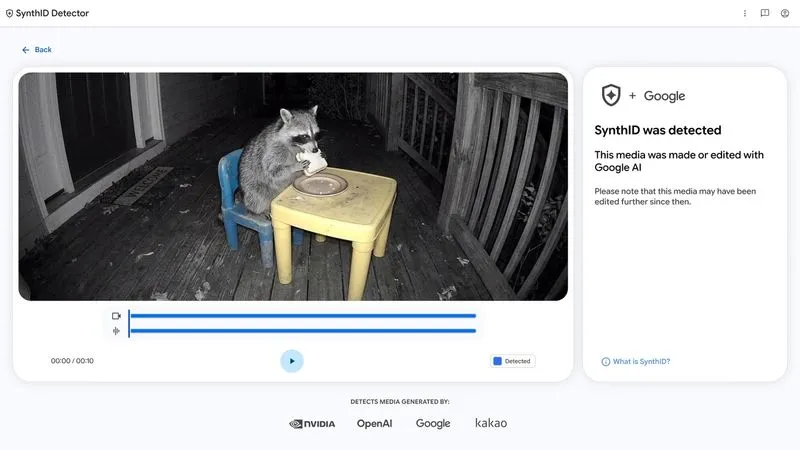
- Read the verdict: for example, “SynthID was detected – this media was made or edited with Google AI”, with a note that it may have been edited further since.
Accepted formats: images JPG, JPEG, PNG, BMP, WEBP, AVIF, HEIC, HEIF, TIFF, TIF, GIF; video MP4, MOV, WEBM; audio WAV, MP3, OGG, FLAC, AAC, M4A. The same check is already built into Search, the Gemini app and Chrome, which Google says handle more than 1 million verification requests a day.
The big limit
The site says it plainly: this is not a general AI detector. It only finds SynthID watermarks. Images from Midjourney, Meta or xAI, which are not partners, will not be flagged, as Numerama points out, and Microsoft and Meta use their own standards. So a “not detected” result does not prove a human made it. Google says the watermark survives cropping, colour changes and compression.
The Rocks take
Useful as a first check before you share something, especially as the biggest generators are on board. Watermarking is spreading to text too: read our piece on OpenAI’s textGrain watermark for ChatGPT in Europe.