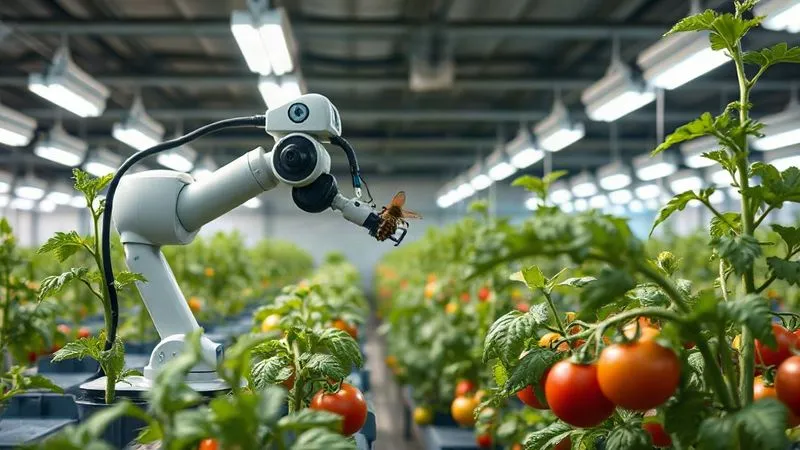
GEAIR 2.0 Dual-Arm Robot Hits 92.8% Stigma Recognition for Hybrid Pollination
- News
- Rocks on Galaxy
- Plantes
- 14 Sep, 2026
- 6
Hybrid seed production still leans on people bent over plants in short pollination windows. At the 33rd China Beijing Seed Industry Conference, researchers unveiled GEAIR 2.0—described as a humanoid embodied-intelligence robot for crop breeding—according to China Daily (September 7, 2026), with the same specs recirculated in trade coverage on September 14.
What changed from the first GEAIR
Led by Xu Cao’s team at the Institute of Genetics and Developmental Biology of the Chinese Academy of Sciences, GEAIR 2.0 swaps a flexible single arm for a dual-arm system that can work around leaves and branches. Stigma-recognition accuracy rises from 85% to 92.8%. In a tomato demo, one hand held a pollen container while the other used a brush; each pollination took under 10 seconds, and one pollen dip supported about 50 flowers, per CCTV figures cited by China Daily.
Robots plus gene-edited flowers
GEAIR stands for Genome Editing combined with AI-based Robotics. The program uses gene editing to create male-sterile plants with more exposed stigmas that robots can find reliably—a “crop-robot co-design” approach detailed in a 2025 Cell paper. Automated tomato cross-pollination reached efficiency comparable to manual work in that study, and the floral-trait strategy was extended to soybean.
What is still research-grade
China Daily frames labor relief and around-the-clock patrols in hot or cold houses as the goal. It does not publish a commercial SKU, hectare throughput, or export timeline. Treat GEAIR 2.0 as a conference-proven prototype with hard accuracy numbers—not a catalog robot you can order for a Midwest greenhouse tomorrow.
Rocks take
For Rocks’ plants lane, the interesting bit is co-design: breeding plants that robots can pollinate may matter as much as better grippers. Watch peer-reviewed field trials beyond demo tomatoes and whether other institutes replicate the 92.8% recognition claim. Sources: China Daily, UkrAgroConsult / Agropages.
Labor windows versus robot uptime
Xu’s comments to Beijing Daily, relayed by China Daily, stress the ergonomics problem: hybrid pollination is repetitive, time-boxed, and physically punishing. Robots that recharge and patrol in heat or cold change the economics even if recognition is “only” low-nineties percent—provided missed stigmas do not wreck seed lot purity. That purity risk is why the gene-editing half of GEAIR matters: exposed stigmas are not a gimmick, they are a reliability feature for machine vision.
International readers should separate the Beijing conference demo from importable farm equipment. Export controls, biosafety rules for edited parental lines, and greenhouse integration costs will decide whether GEAIR-style systems leave Chinese breeding centers.
FAQ
Is this only for tomatoes? Demo focus is tomato; soybean floral traits for robotic pollination are also cited.
Can farms buy GEAIR 2.0 now? Coverage describes a conference unveil, not retail availability.