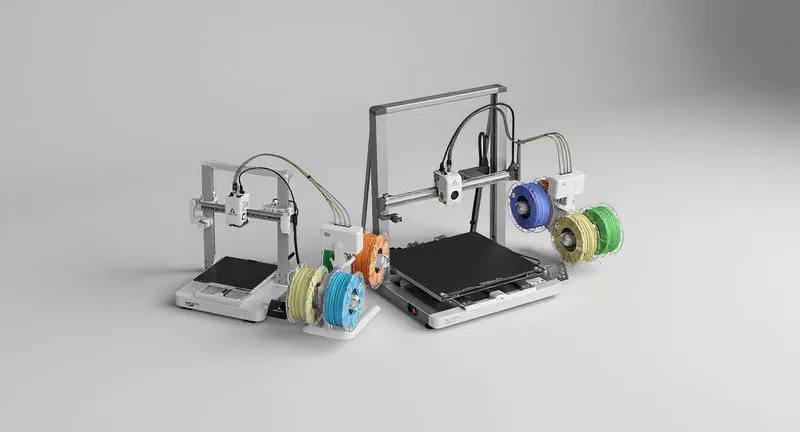
Creality Ender-3 V3 Mega and Neo: a 420 mm 3D Printer for $669 and a $329 Starter
- News
- Rocks on Galaxy
- Tech
- 16 Oct, 2026
- 0
The Ender-3 is the printer many makers started on, and Creality is stretching the family in both directions. On October 15, 2026, the company launched the Ender-3 V3 Mega and the Ender-3 V3 Neo, available to order now from its official US and European stores. Creality says the Ender-3 series has shipped more than 4 million units in nine years.
Ender-3 V3 Mega: go big
- 420 × 420 × 420 mm build volume, to print large parts in one piece or fill the plate with batches
- Flexible TPU 85A–95A printing with the optimised Sprite 2 extruder (direct from spool only, not through the CFS Nano or relay)
- High-rigidity metal frame, dual Z motors, dual Y motors and vibration compensation
- Speeds up to 500 mm/s (Creality figure)
Creality pitches it for cosplay props, furniture parts and batches of functional prototypes — or for small print farms.
Ender-3 V3 Neo: the starter
The Neo has a 220 × 220 × 220 mm build volume, fully automatic bed levelling and a quick-swap nozzle, aimed at first-time users, students and young makers.
Four colours with CFS Nano
Both printers have automatic filament relay: when a spool runs out, they switch to a backup. The Combo versions add the CFS Nano for four-colour printing; it reads the type and colour of compatible Creality RFID filaments and warns you when a spool runs low.
Prices and availability
- US (early-bird, Oct 15–Nov 10): Mega Combo $669, Neo Combo $329
- Europe (Oct 15–Nov 30): Mega Combo €699 with four free filament rolls, Neo Combo €329 with two
Rocks take
For a connected-home DIYer, a 3D printer is the tool that turns ideas into objects: sensor enclosures, Raspberry Pi cases, wall brackets for a dashboard tablet. A 42 cm cube is overkill for most of that, but TPU support is handy for flexible gaskets and cable grommets, and the Neo’s auto-levelling removes the most annoying part of starting out. These are vendor specs — print quality is what we’ll judge in a real test.