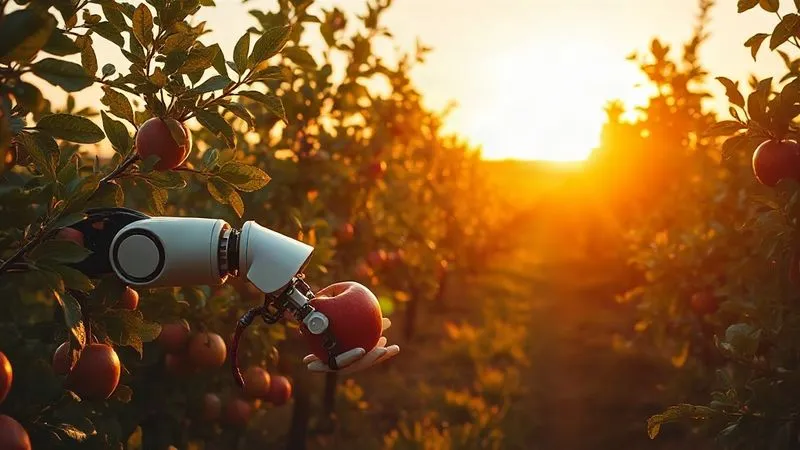
Cornell Leads $7.5M USDA Project for Multipurpose Orchard Robots
- News
- Rocks on Galaxy
- Plantes
- 13 Sep, 2026
- 2
Apple growers are not waiting for another single-purpose harvester demo. On September 3, 2026, the Cornell Chronicle reported a newly announced four-year, $7.5 million U.S. Department of Agriculture Specialty Crop Research Initiative grant that funds a Center of Excellence for Orchard Robotics inside Cornell’s Department of Biological and Environmental Engineering.
Why growers are squeezing the robots button
Gilbert Plath of Washington Fruit and Produce Co. told Cornell that labor has jumped from about 45% of costs fifteen years ago to over 60% today, while apple prices barely moved for two decades. The project targets risky, repetitive orchard work—ladder falls, machinery accidents, repetitive-motion injuries from long harvest days—not just wage charts.
Multipurpose by design
Led by Cornell’s Manoj Karkee with Washington State’s Matthew Whiting, the team is building robots for pollinating flowers, thinning fruitlets, harvesting apples, and weeding rows. Fresh Fruit Robotics CEO Avi Kahani’s feedback loop is explicit: expensive harvest-only machines fail ROI tests; year-round tasks (winter pruning through fall harvest) sell better to growers.
Who is in the coalition
Partners span Cornell, Washington State, Oregon State, Penn State, Michigan State, Carnegie Mellon, Stanford, and Israel-based Fresh Fruit Robotics, with Federal Capacity Funds via Cornell AES and grower outreach through Cornell Cooperative Extension. Workstreams include orchard digital twins, canopy perception AI for thinning decisions, and social/economic adoption studies—because a brilliant arm that farmers will not buy is still a lab toy.
Rocks take
This is grant-funded R&D, not a preorder page. For Plants readers, the signal is serious public money behind multipurpose orchard autonomy in the U.S. apple belt—the right problem framing even if commercial fleets are years out. Source: Cornell Chronicle.
Economics first, then end-effectors
Cornell’s September 3 Chronicle piece grounds the grant in grower math, not science-fiction orchards. Gilbert Plath’s Washington operation saw labor climb from roughly 45% to more than 60% of costs over fifteen years while apple prices stayed roughly flat for two decades. That squeeze is why Fresh Fruit Robotics CEO Avi Kahani emphasizes multi-task robots: a harvest-only machine that sits idle most of the year rarely clears ROI for growers.
Karkee’s team is pairing soft manipulators and canopy perception models with digital twins and Cooperative Extension outreach in New York—second in U.S. apple volume, first in variety diversity, per Cornell. Partners at Carnegie Mellon and Stanford signal serious autonomy research; the SCRI funding and Cornell AES capacity funds signal multi-year continuity rather than a one-off demo day.
Rocks Plants readers should still expect years of field trials before a turnkey robot replaces harvest crews. The publishable fact for September 2026 is the $7.5 million Center of Excellence itself—and the explicit multipurpose scope: pollinate, thin, harvest, weed.
FAQ
Are robots in commercial orchards now? The story covers prototypes and a new research center; Kahani frames commercial deployment as a near-term hope, not a shipped product line.
Why apples? Apples are the most-consumed U.S. fruit (~$21B economy); NY ranks second in production and first in variety diversity, per Cornell.